
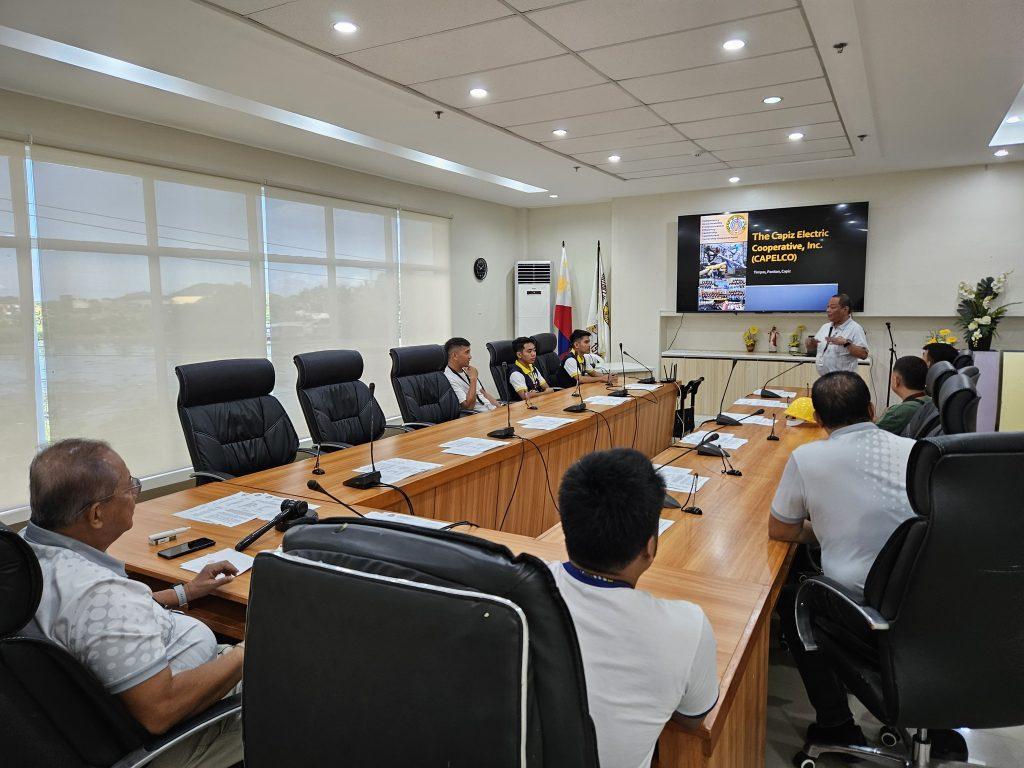
Note: This story has been updated last October 16, 2024.
Getting electricity can do many things for a household – it provides a safe source of lighting at night and is cheaper than the alternative of using gasoline-fueled lamps. Electricity powers communication devices, which are essential in times of emergencies.
In Capiz, a province in Central Philippines, one of the challenges was some households were not connected to the electricity grid.
“What is preventing marginalized households in Capiz from connecting to the power grid?” Rey Cordenillo, in charge of the Membership Services and Development Division of Capiz Electric Cooperative (CAPELCO), has been asking himself this question since 2021. Although CAPELCO had a high market penetration percentage of 87% at the end of 2020[1], Rey was concerned with the remaining 12%, which comprises about 25,000 or so households. Because he had worked in local governments in the past – and even served as Acting Barangay Captain – he had learned to pay attention to the circumstances of marginalized households.
Rey knew that households that were not connected to the power grid used kerosene for lighting. Kerosene is an expensive alternative. Untended, open flames can lead to accidents and fires. The fumes from kerosene lamps are unhealthy. For these and related reasons, Rey wanted to make it easier for marginalized households to get energized.
When he joined the Development Entrepreneurship Mentoring Program in January of 2021 Rey thought that by studying the entire process that a household goes through, from application filing to turning on their first light bulb, he could discover the constraints that keep households from getting connected to CAPELCO. Then he could address this constraint with an appropriate policy. He learned over time that it was not going to be that simple. He had to undergo several iterations to find and address the binding constraint, and finally help formulate a policy that helped marginalized households.
The first iteration started with Rey conducting process documentation. Through this exercise, he learned that the requirements and processes for energization were complicated. So much so that electricians offered their services as middlemen/facilitators. But because they also charged for their services, the practice only added to the cost of getting a home connected to the power grid.
Having identified this constraint, Rey proposed a solution: a communication campaign telling households to skip the middlemen and apply directly with CAPELCO. At about this time, Rey was responsible for “CAPELCO Hour”, the cooperative’s regular radio program. Rey used this time to run a “NO TO FIXER campaign”, in which he and his team exhorted applicants to skip the middlemen and apply directly with the coop.
At about this time, Rey was given an additional assignment: to manage the cooperative’s social media presence. So he also used social media for the “NO TO FIXER” campaign.
Interaction with radio listeners, feedback from social media, and a review of applications showed Rey that the number of middlemen-electricians decreased. However, he noted that applications from marginalized households had not increased. He deduced that middlemen contributed to the problem, but they were not the binding constraint.
He went back to the drawing board, and this time he researched the formal rules relevant to his problem. Soon he was convinced that the binding constraint was the requirement that applicants have to be CAPELCO members before their homes could be energized. He explains: “An Electric Cooperative, unlike an electric power distribution utility, requires membership for energization. Thus, a household connected to the CAPELCO system is not only a consumer but also has to be a cooperative member and hence, a co-owner of CAPELCO – hence the term, Member-Consumer-Owner, or MCO”.
Since membership must be approved by the Board of Directors, which meets only twice a month, applicants must wait at least two weeks before their membership application can be approved.
At this point, the six-month Mentoring Program had ended. Nevertheless, Rey continued to research the formal rules.
Further research revealed that the National Electrification Administration (NEA) requires that, upon payment, applicants must be energized within 48 hours. He also learned that the 2004 “Magna Carta for Residential Electricity Consumers,” stated that a “consumer has the right to be connected to a distribution utility for electric power service after the consumer’s full compliance with the distribution utilities and local government unit’s requirements.”
Rey thought he had the solution to the membership constraint – they should treat the applicant as a consumer first, get him connected to the power grid, and then give him reasonable time to comply with membership requirements. Rey explained his ideas to his principals, and his ideas were implemented.
When the new process was put in place, Rey learned from the coop’s electricians that households were connected much faster than before. But when he looked at the application records, he saw that very few of the applicants were marginalized households. He had to accept the fact that while membership requirements were a constraint, these were not binding constraints for the poorer members of the community. He still had to find the binding constraint.
In the latter part of 2023, the Coop’s Board of Directors conducted consultations in barangays (Rey said it was in response to a requirement by the National Electrification Commission). Rey was required to join them, as the head of Membership Services and Development Division.
It was in these consultations that listened to the people, and learned that the binding constraint is simply that marginalized households do not have the money to pay for power connection, and don’t have the money to buy the essential materials needed for energization (such as circuit breakers, switches, light bulbs, wiring, etc).
Rey continued to listen as Board Members talked about how they could address this constraint. Based on their discussions, Rey and colleagues drafted a program to help marginalized households to connect to CAPELCO. The Board officially adopted the program as “Socialized Energization of Marginalized Applicants for Electric Service Connection” or SEMA through Resolution 19, series of 2023.
In SEMA, CAPELCO advances the cost of one electrical outlet, essential safety breakers, and other essential electrical materials, estimated at 3,000.00 pesos. This amount is amortized over 12 months, and the cost is added to the household’s power bill. The monthly amortization comes out to about Php 250, which is still less than the cost of kerosene (Php 20/day or Php 600/month) for their lamps. To cut the cost of delivering this service, the Cooperative fields Electrical Engineering students to provide the service as part of their on-the-job training.
Rey estimates that as of July 2024, there are still 8,000 households to be connected. He thinks a big part of these households are marginalized, and therefore the market segment needs SEMA. Since the program started, 212 marginalized households have been connected. The number of pending applications is 271 – and growing. Consequently, the Coop is stepping up training electrical engineering students to cope with SEMA applications.


Notes on a Development Intrapreneurs’ Experience
As an employee, Rey had regular duties to attend to and could not spend much time on his reform. The Covid pandemic also constrained his ability to gather data and talk with people in the field. In the middle of the mentoring program, he was assigned to a new project linked to the Coop’s social media, which further limited his time for reform – but enabled him to listen to the people, as well as to the front-liners.
Thus, Rey was able to explore the constraints that prevented households from energization, and he was able to test ideas to address these problems. It took severa iterations before he found the “binding constraint” – the constraint that, if not removed, would keep households from connecting to CAPELCO. Having identified this binding constraint, they were able to find a solution that truly helped marginalized homes get energized.
[1] Of 211,083 households surveyed in 2020, 185,331 had already been connected to the Cooperative’s power grid by the end of 2020.
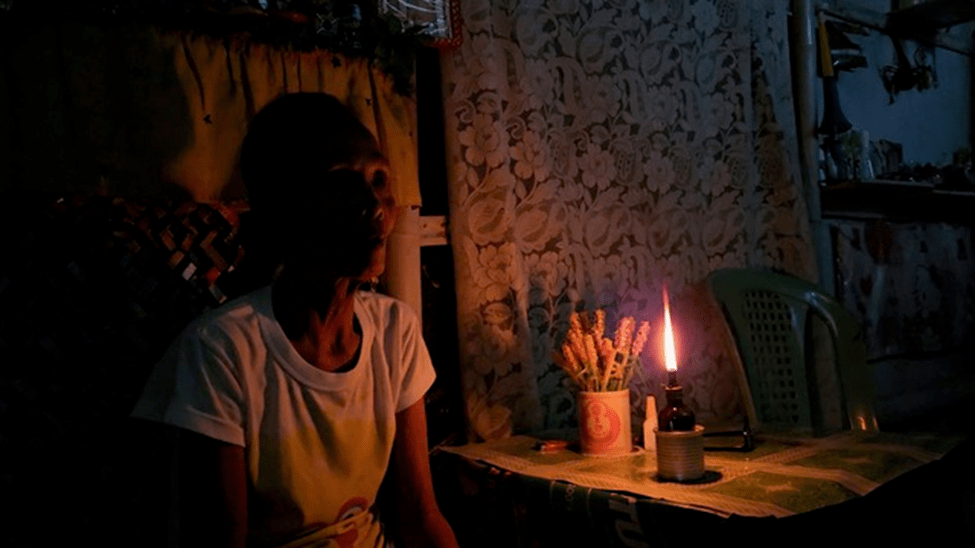
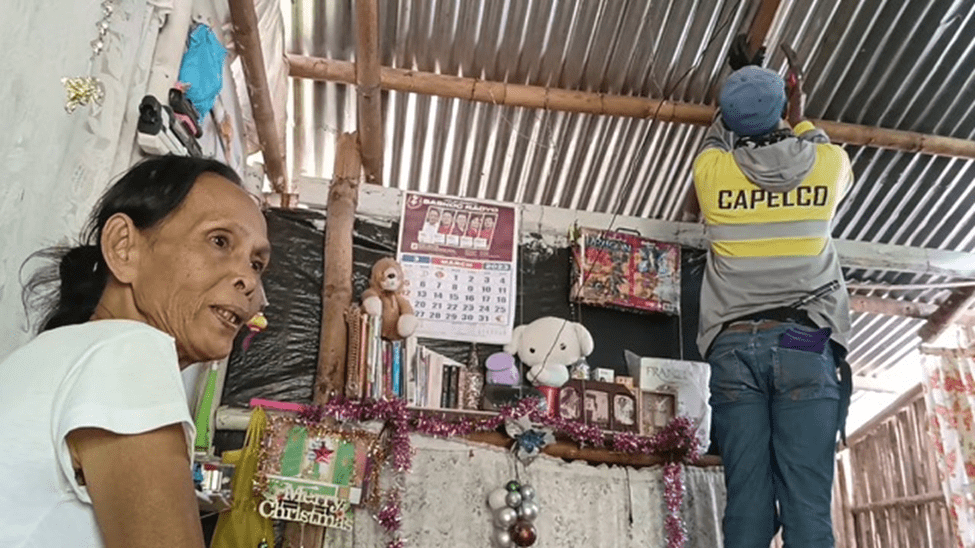
Florinda Patigan, 67 years old, used to spend Php 20.00 per day for kerosene, for night-time lighting. She is one of the first beneficiaries of the SEMA program.